
Links: Part – 1 | Part – 2 | Companion Guide
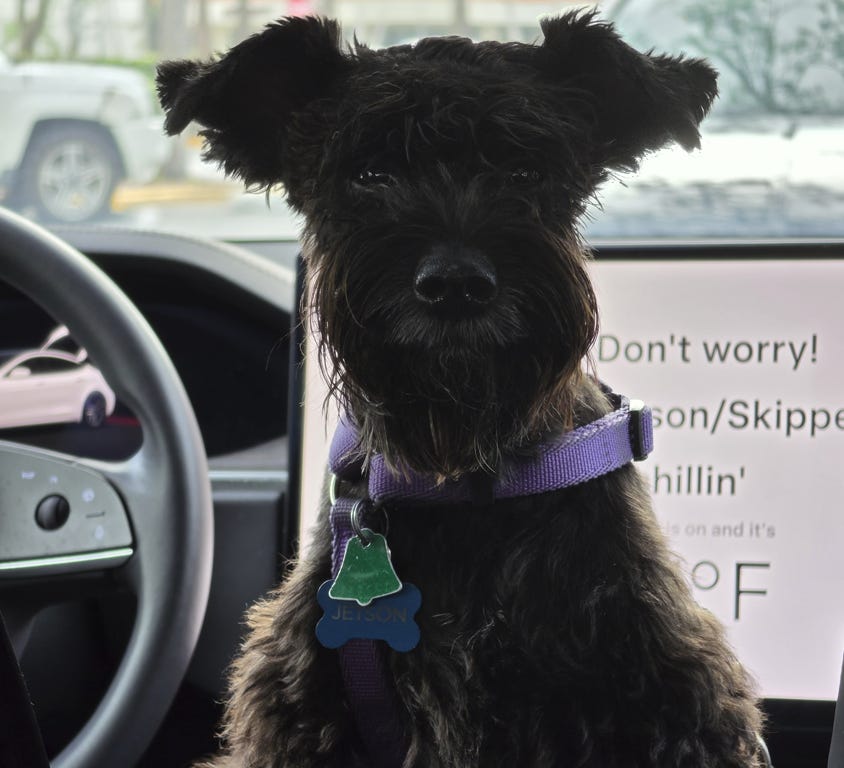
Jetson passed away on Saturday afternoon, August 15.
For nearly ten months, keeping him healthy and safe had become the center of my life. I’ve been unemployed for the past 13 months, which gave me something most people in my situation might not have had; virtually unlimited time to dedicate to his care. I spared no expense, even at a time when I was struggling financially. If there was something Jetson needed, the cost simply wasn’t part of the decision. My head knows I did everything humanly possible for him. My heart tells me I failed him.
The last year has been the worst year of my life, both personally and professionally. Having so much time to focus on Jetson was both a blessing and a curse. I became too reactive to every setback, and in hindsight, having something else, especially work, to occupy part of my mind would have been healthier. Instead, his health became the center of my world. I’m truly traumatized by the experience. I’m feeling things I’ve never felt before, and that scares me.
A Short Recap of Part – 1
Jetson was diagnosed with diabetes on October 21, 2025. Almost immediately, I discovered one of the things that would make managing his diabetes so difficult; he would not allow me to give him his insulin shot when it was just the two of us. I had to find ways to outsource that part of his care every single day.
Three weeks later, on November 11, Chance, Jetson’s longtime companion, passed away unexpectedly. I was devastated, and Jetson was too. At the same time, I was trying to manage his diabetes along with pancreatic issues and a history of bladder stones. Because those conditions created conflicting dietary requirements, I paid two veterinary nutrition specialists (VET6 and VET7 listed below) to formulate a custom diet. For nearly ten months, I prepared Jetson’s meals from scratch twice a day. It was a lot of work, but I knew diagnostically that the diet was helping him and, most importantly, he loved it.
I ended Part-1 on December 4, 2025, still trying to get Jetson’s blood sugar under control.
A Short Recap of Part – 2
By late January, everything was finally under control. For one brief day, it felt as though persistence had finally produced stability. Literally the next day, Jetson began bumping into things. An ophthalmologist (VET8) diagnosed him with aggressive diabetic cataracts and told me he would likely be blind within two weeks. He eventually did lose his sight, but thankfully only for a few days. On February 19, he underwent successful cataract surgery. Giving Jetson his eyesight back meant everything to me.
Two weeks later, during an ordinary walk, he ingested what I believe was a discarded marijuana edible and became severely ill. For a diabetic dog, appetite loss is a major problem because it destabilizes everything. It took roughly two weeks for him to recover, and by that point, I was already exhausted from trying to keep him healthy through one problem after another.
I ended Part–2 on April 16, 2026. Jetson was stable all around, and I was just about to bring Skipper, another Miniature Schnauzer, into his life as a new companion. What I didn’t know at the time was that the worst was still to come.
Introduction to Skipper
Jetson was very social and loved other dogs and people. After losing Chance, he was truly depressed, and I knew he needed a friend. By this point, Jetson was finally stable, and bringing another dog into his life felt long overdue.
Skipper was 10 months old when I brought him home; a little smaller than Jetson, extremely dog-friendly, but highly skittish around people. He clearly struggles with anxiety and is currently taking the equivalent of doggie Prozac. That added another layer of stress to an already difficult situation for me. It took exactly one month to the day for Jetson to really adopt him, but from that point on, they were besties.
The thing that stands out most about Skipper is how sensitive he is, almost empathic. He clearly knew when Jetson wasn’t feeling well and would soothe him in his own unusual ways. Sometimes Skipper would lie against Jetson or partially on top of him when he was sick. Even more interesting, he would gently gnaw on Jetson’s ears. Jetson loved it. It seemed to relax him, and over time, it became a little ritual between them.
I don’t know exactly what Skipper understood about Jetson’s illness, but he understood something. He knew his friend needed comforting. The pictures below tell the story.

The Pancreatitis
On April 23, Jetson once again ate something off the ground, which I believe was some type of spoiled food. The very next day, he became violently ill and was diagnosed with acute pancreatitis. He spent four days and three nights in the ER hospital (VET2). At one point, they had to place a tube through his nose and into his stomach to remove accumulating fluid. It was agonizing to witness and terribly uncomfortable for Jetson.
During that hospitalization, I made a promise to myself; if Jetson became that sick again anytime soon, I would not put him through another experience like that.
Jetson eventually recovered and became Jetson again. Those recoveries were what kept me going. Every time he bounced back, I wanted to believe that maybe we had finally gotten through the worst of it.
May Through Mid-August: The Relentless Cycle
By June, it didn’t take a data scientist to see the pattern. It reminded me of the movie Groundhog Day. In the film, Phil Connors, played by Bill Murray, repeatedly tries to save an elderly homeless man who dies. Because Phil is reliving the same day, he gets another chance and then another. He feeds the man, gets him medical care, and tries everything he can think of, but ultimately the outcome remains the same.
My version of Groundhog Day happened roughly once a month and followed the same sequence. Jetson would become ill, and I would respond; adjust his food, monitor his glucose, manage his insulin, get veterinary care, get him eating again, and slowly get him stable. I went through numerous glucose sensors during those months because I was constantly trying to understand what his blood sugar was doing. Jetson would always rebound, and seeing him healthy again brought me true joy. For a little while, I could breathe again, only for the cycle to begin again.
It was simply too much for one little dog to keep enduring, and I was wearing down right alongside him.
August 14–15: The Decision I Never Wanted to Make
Since Jetson’s last episode, everything had been going beautifully. He was happy and healthy, and he and Skipper were having a great time together. For a brief moment, I thought maybe I had finally turned the corner. Then, on the morning of Friday, August 14, exactly one month to the day since his last episode, he ate breakfast and received his regular insulin shot. He seemed a little off, but not enough for me to think much of it. That evening, however, he refused to eat, and I knew something wasn’t right.
I took him to the ER (VET5) that night. They knew Jetson and his medical history well. Maybe this was simply a hiccup, and he would feel better in the morning, as had happened before. We decided to make him comfortable, bring him home for the night, and take him to his regular veterinarian (VET1) when they opened Saturday, if he still wasn’t feeling better.
On Friday night, Jetson slept well. I didn’t.
A month earlier, on July 21, Jetson had seen his ophthalmologist (VET8). His eyes were healing well from surgery, so there was no need to see him again for another month. His next appointment was scheduled for August 18. I distinctly remember thinking that, given everything we had been through, I wouldn’t be surprised if Jetson wasn’t here for that appointment. Even having that thought was devastating to me at the time. I hated that my mind had even gone there.
Now we were only a few days away from August 18.
Saturday morning, Jetson initially seemed fine. We went for our normal walk, and nothing seemed out of the ordinary. When we came back into the house, he began vomiting bile. It wasn’t the worst episode I had seen, but it was alarming, and I knew the pattern. I believed we were heading into another round of pancreatitis.
This was the hardest decision I had ever made for any of my dogs because I knew there was a very real possibility we could go through the gauntlet again and get Jetson healthy. We could hospitalize him, treat the pancreatitis, get him eating, re-adjust his insulin, and eventually he would come home. But to what end?
That very morning, I had to accept that loving Jetson no longer meant finding another way to save him. It meant having the courage to stop asking him to endure another attempt simply because I wasn’t ready to lose him. It was agony.
And that is why the thought I had after his July 21 eye appointment has haunted me ever since. My rational mind tells me I didn’t manifest this outcome; I had simply lived through enough episodes to recognize the pattern. My heart still wonders whether I somehow made it happen. I know that isn’t rational, but I can’t seem to let it go.
I am heartbroken in ways I have never experienced.
What I Never Imagined
Of all my dogs, Jetson is the most unique. He seemed human in ways I had never experienced in a dog before. The best word I can use to describe his character is “merry.” He was simply a very happy fellow. What I realize now, and what makes losing him even harder, is that I never considered the possibility that I might have to raise Skipper without him.
Skipper is young, anxious, and unsure of people, while Jetson was confident, social, and incredibly well adjusted. I thought I was bringing Skipper into our life. I never imagined that only four months later, it would become just Skipper and me. I simply assumed Jetson would be there to help me raise this little guy. Now I have to figure out how to do it without him.
What I hope someone takes from Jetson’s story is that being told your dog has a treatable disease is not the same as being prepared for what comes next. When Jetson was diagnosed with diabetes, I was thrust into a world I knew nothing about; insulin injections, glucose monitoring, diet, complications, and decisions I never imagined I would have to make. There is a terrible boundary between what modern medicine can treat and what love desperately wants medicine to be able to fix. I crossed that boundary again and again with Jetson. Part of the reason I wrote these articles and why I’ve written a companion guide with practical tips for other owners, is to help someone else feel a little less lost when they suddenly find themselves there.
I’m struggling personally and professionally in ways that are completely new to me, and it’s scary. I’ve lost two dogs in ten months, and I know that I need time to grieve and heal from everything I’ve been through. At the same time, Skipper and I both have to find our way toward a new normal. Skipper was so kind and sensitive with Jetson, he deserves a wonderful life. I owe that to Skipper, and in a way, to Jetson too.
I just wish Jetson were still here…
______
EDITOR’S NOTE
In Parts 1 and 2, I anonymized the veterinary practices involved in Jetson’s care. In this final part, I have chosen to identify the clinics that helped us along the way, while continuing to keep individual veterinary professionals anonymous.
It truly took a village to get Jetson as far as we did. For nearly six months, every day Jetson was home, I had to find a neighbor willing to hold him so I could administer his insulin. I will always be grateful to those neighbors, as well as the veterinary clinics, specialists, emergency hospitals, and technicians who helped us through an extraordinarily difficult ten months. I am also deeply grateful to the team at Linton Square Pharmacy, who filled Jetson’s prescriptions and took a genuine personal interest in his health and well-being.
I am especially grateful to Jetson’s veterinary team at TLC (VET1), who were consistently there for both of us through one crisis after another, and to the team at Veterinary Eye Institute (VET8), who gave Jetson his sight back and provided such thorough care throughout his treatment. Giving him the ability to see again was one of the greatest gifts anyone could have given us.
I also want to acknowledge Dr. Patricia Kallenbach (VET9), a holistic veterinarian and personal friend, whose professional guidance and friendship meant a great deal to me throughout Jetson’s illness.
Every veterinary practice listed below played a role in helping Jetson, whether through routine care, emergency treatment, specialty care, nutrition, or simply being there when I needed help. I am deeply grateful to all of them.
Legend for Veterinary Clinics & Technicians
VET1: TLC Animal Hospital | Boca Raton, FL
VET2: ACCESS Specialty Animal Hospital | Royal Palm Beach, FL
VET3:
24/7 emergency veterinary clinicVET4: Dr. Q’s Pet Vet | Delray Beach, FL
VET5: VEG Emergency Vet | Boynton Beach, Florida
VET6: Healing Heart Veterinary Clinic | Boynton Beach, Florida
VET7: Cornell College of Veterinary Medicine
VET8: Veterinary Eye Institute | Deerfield Beach, FL
VET9: Dr. Patricia Kallenbach, Holistic veterinarian | FL
VETTech1: Mobile veterinary technician
VETTech2: Mobile veterinary technician
Pharmacy1: Linton Square Pharmacy | Delray Beach, FL
Erik, there are simply no words for a loss this deep. Jetson was loved beyond measure, and every chapter of his life reflected the extraordinary love, devotion, and care you poured into him.
I hope, somewhere within all of this grief, you are able to extend some of that same compassion and tenderness to yourself. You gave so much of yourself to Jetson, through an already incredibly difficult season of your own life, and even now, in the midst of your heartbreak, you are thinking about how what you learned might help someone else.
My heart is with you and sweet Skipper as you both grieve, heal, and learn how to move through this world without Jetson. He will forever be family, forever loved, and forever missed. ❤️🐾
Skipper came at just the right time to offer comfort and compassion to Jetson and you 🙏❤️🥹 Sending love and hugs to you both 🤗 🤗