
Links: Part – 1 | Part – 2 | Part - 3
DISCLAIMER: I am not a veterinarian, and nothing in this article should be considered veterinary or medical advice. I am simply sharing some of the challenges I encountered along the way and the practical solutions that helped me navigate them.
The day your veterinarian tells you, “Your dog has diabetes,” your life changes. From that point forward, every day will be different for as long as your dog is living, you just may not realize yet how different.
There is no simple Diabetic Dog for Dummies handbook that prepares you for everything that may follow. In Part – 1 of this trilogy, I wrote about some of the challenges I encountered, but I did not provide any practical lessons I learned from them. This companion guide is intended to do that; to share some of the things I wish I had known from the beginning.
Here are the links to Part – 2 and Part – 3.
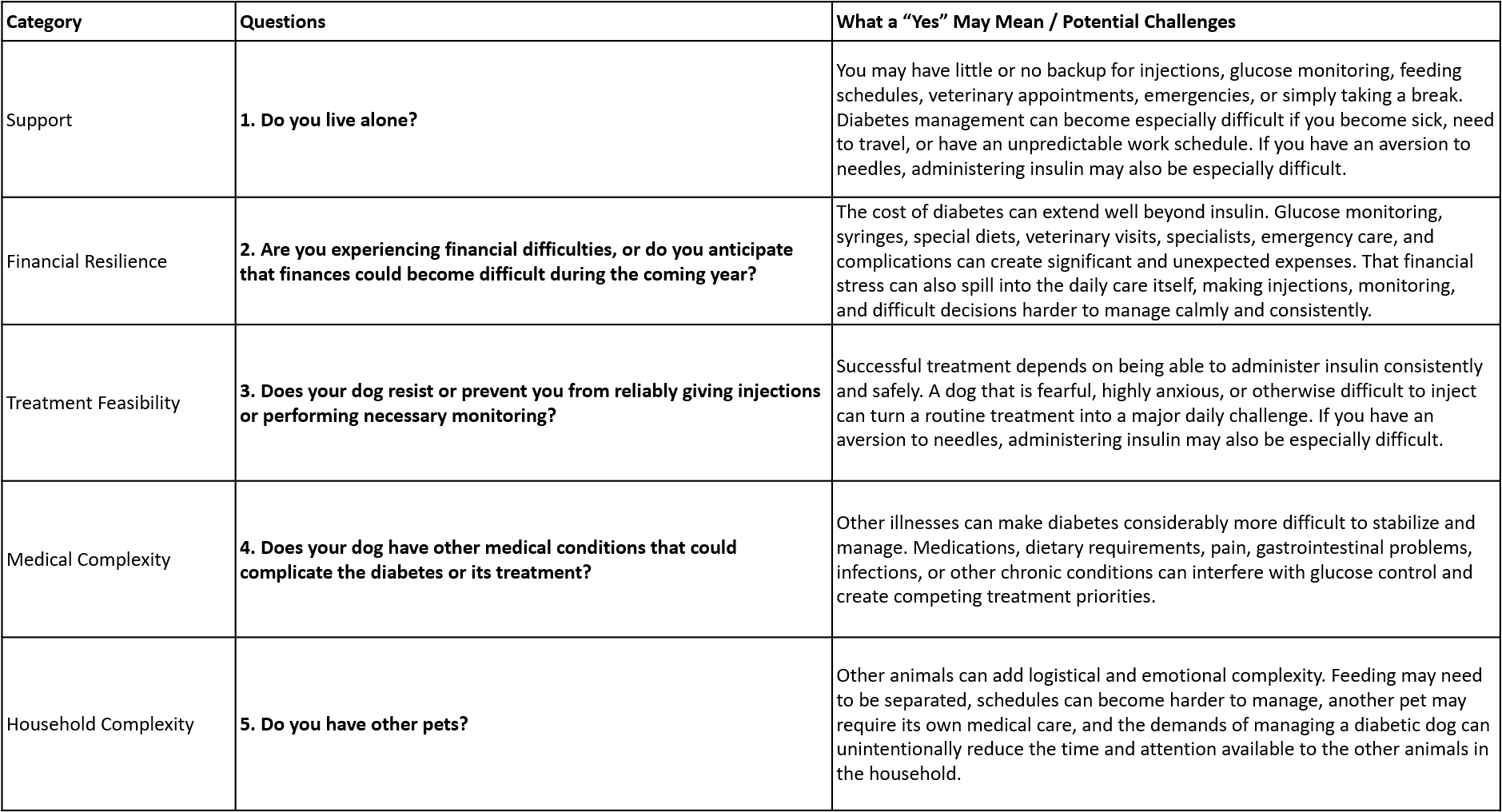
Canine Diabetes Caregiving Risk Matrix
Think of the five questions below as a simple way to assess the potential complexity of caring for a diabetic dog. Zero “Yes” answers suggests a lower management burden, while five “Yes” answers indicates a high-risk caregiving situation with multiple challenges occurring at once. Not every ‘Yes’ carries the same weight; some challenges can have a much greater impact than others.
In my case, the answer was Yes to all five questions. The areas that affected me most were Support, Treatment Feasibility, and Medical Complexity. Ultimately, I believe Medical Complexity affected Jetson the most. I was not simply managing diabetes; I was trying to manage several conditions that interacted with one another, making the diabetes increasingly difficult to control.
The purpose of this matrix is not to predict an outcome. It is to help owners identify where their greatest challenges may be early, so they can prepare for them before those challenges become overwhelming.
Track Everything
If you answered Yes to Medical Complexity, keep a detailed log from the beginning. A simple spreadsheet or document can be invaluable for tracking dates, symptoms, medications, dosage changes, veterinary visits, test results, and outcomes.
I wish someone had told me to do this earlier. When multiple medical issues begin overlapping, it becomes difficult to remember exactly what happened and when. A clear record can help you recognize patterns, communicate more effectively with your veterinary team, and give everyone involved a better picture of your dog’s medical history.
The Three Ps: Pinch – Poke – Plunge
I believe one of the biggest challenges of canine diabetes can be something that sounds deceptively simple; giving the insulin shot. Most people have never had a reason to become comfortable giving an injection, and doing it to your own dog can feel intimidating at first.
1. Your dog may behave very differently at home than at the vet.
Jetson was the perfect patient at the vet and rarely objected to injections. At home, it was a completely different story. If you experience this, the most important advice I can offer is; stay calm! Your dog can sense your anxiety, and becoming frustrated or nervous can make the process harder for both of you. There are plenty of instructional videos that demonstrate the mechanics of giving an insulin injection, but learning to remain calm is just as important.
2. Prepare the syringe before you approach your dog
Before drawing the insulin, I found it helpful to leave the needle capped and move the plunger back and forth a few times. Some syringes can feel a little stiff, and doing this helped the plunger move more smoothly. I would then bring the plunger to the exact dose I intended to give, a simple mental reminder of the amount I was about to administer.
Next, push the plunger fully back in, insert the needle into the insulin vial, and draw up the prescribed dose. Double-check the measurement before giving the injection and make sure there are no visible air bubbles that could affect the accuracy of the dose. Always follow the specific handling and injection instructions provided by your veterinarian for the insulin and syringes you are using.
3. Remember; it is a subcutaneous (SubQ) injection.
The insulin is injected just beneath the skin, and Jetson usually tolerated it very well. I eventually reduced the process to what I called the Three Ps: Pinch – Poke – Plunge. If your dog is resistant to the injection, I found that it helped to do all three steps quickly and confidently. Don’t fuss too much with the pinch; with Jetson, too much handling of the skin sometimes seemed to be the trigger that made him flinch. The entire process can be completed almost as quickly as you can say, “Pinch, Poke, Plunge.”
I also learned through experience that the angle of the needle seemed to matter. If I came in from the top or at too much of an angle, Jetson would sometimes flinch. I consistently had the best outcome when I inserted the needle parallel to his body, just beneath the skin. Your veterinarian can show you the proper technique for your dog, but for Jetson, keeping the needle parallel and completing the process quickly made a noticeable difference.
4. Find the environment that works for your dog.
At some point, I realized I was probably never going to completely desensitize Jetson to receiving an injection from me when we were alone. What I did discover was that certain confined environments made it easier. For a while, I could give him his shot in the front seat of my car. Eventually, of course, Jetson figured out what I was doing and put the kibosh on that strategy too.
5. Don’t assume you have to do everything alone.
Most diabetic dogs require insulin twice a day, although different insulin regimens may be used depending on the dog and should be determined by a veterinarian. Jetson’s internist ultimately put him on a long-acting insulin (Degludec) that required only one injection per day. That made his care possible for me, even when I had to outsource the injection.
For the first couple of months, I took him to a veterinarian around the corner every day, where they gave the injection for only $4 per shot. Eventually, I knew I needed a more sustainable solution, so I enlisted neighbors to help hold and distract him while I gave the shot. I did this almost every day for roughly six months. Giving some treats while having another person holds him, whether familiar or unfamiliar, often distracted Jetson enough to make the injection process easy.
6. Long-acting insulin came with an important tradeoff for us.
Once-daily insulin made the injections more manageable, but it also created another challenge in Jetson’s particular treatment plan; his eating became critical. I could not give him his normal dose until he ate in the morning, and I needed him to eat again later in the day. When he stopped eating normally, managing the insulin became much more complicated.
Hypoglycemia was a very real concern in our case. Jetson experienced serious low-blood-sugar episodes twice, including one that required an emergency veterinary visit. This is why changes in appetite should never be treated casually in a diabetic dog; your veterinarian should give you specific instructions about what to do with insulin when your dog refuses food. Veterinary guidelines similarly recommend contacting the veterinarian when a diabetic pet does not eat rather than simply giving the normal dose automatically.
The larger lesson I learned was that giving the shot itself is only part of the challenge. You have to find a routine that works for your dog, for you, and for the realities of your household, and sometimes that requires creativity, patience, and help from other people.
Handling and Storing Insulin
Know exactly how your insulin should be handled. Some types should be gently rolled, some may require mixing, and others should not be shaken or rolled at all. Jetson’s degludec, for example, required no mixing. Improper handling can affect the insulin, so always follow the manufacturer’s instructions and your veterinarian’s guidance.
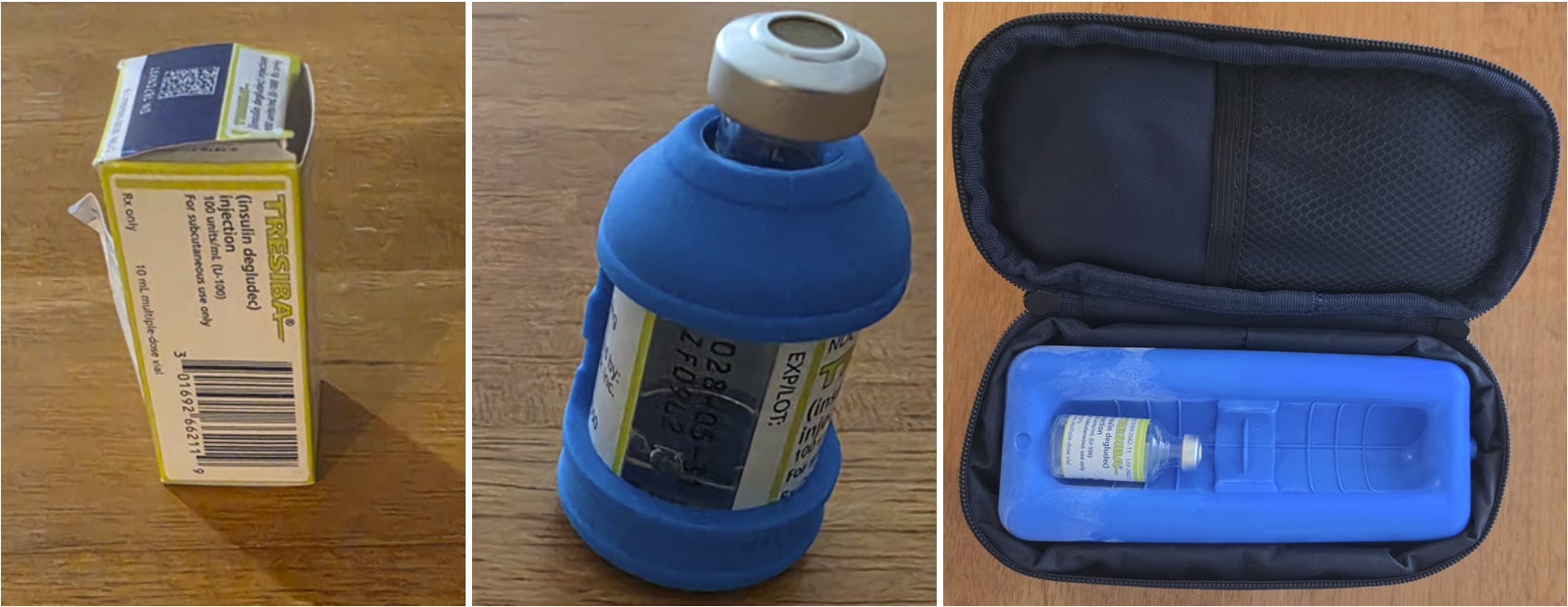
Keep the insulin in its original box when storing it in the refrigerator. The box helps protect the vial and keeps the medication and labeling together. See image.
Put the insulin back in the refrigerator immediately after filling the syringe. Make this the very first thing you do before moving on to anything else. Trust me, when you are distracted or in a hurry, it is surprisingly easy to forget.
Consider using a protective sleeve for the vial. Insulin vials are small, slippery, and breakable. A vial protector can provide some extra protection if it slips out of your hand. See image.
Plan ahead for travel or time away from home. Depending on the insulin you use and its storage requirements, you may need an insulated medication travel case or cooler. Always check the specific temperature requirements for your insulin before traveling. See image.
A simple cooler can work for short trips. At times, I used a small insulated cooler with reusable ice packs and kept the insulin vial inside its original box. The important thing is to keep the insulin at the temperature recommended for that particular product and avoid allowing it to freeze.
Personally, I kept the syringes separate from the cooler. I had no medical evidence that a cold syringe would cause a problem; I simply preferred not to inject Jetson with a syringe that had been sitting directly against an ice pack or in a very cold environment.
Put the travel case somewhere you cannot overlook it when leaving the car. I learned this lesson the hard way after leaving Jetson’s insulin in the car too long and having to discard it. Place the cooler somewhere that physically gets in your way when you exit, such as on the passenger seat or directly beside something you know you will take with you. The goal is simple; make it difficult to forget.
The challenge of food
Of all the challenges I faced, food was one of the most frustrating and complicated. Nutrition can become especially difficult when a dog is dealing with multiple medical conditions, and in Jetson’s case, the dietary needs associated with diabetes, pancreatitis, and bladder stones did not always align. Miniature Schnauzers are also predisposed to several of these conditions.
As I discussed in Part – 3, I paid two veterinary nutrition experts to formulate a custom diet for Jetson, which I then prepared for him from scratch. It was the best fit for his medical needs, and he genuinely enjoyed the food. The tradeoff was that it was both expensive and time-consuming to prepare.
My bigger concern was sustainability. I could manage the routine while I was home, but I often wondered what would happen when I needed to travel. A dog sitter would have to take on additional preparation and responsibility, which added another layer of cost and logistics. If you live alone, I believe this is an especially important consideration.
Jetson’s situation was more complicated than most, and homemade meals may not be necessary or practical for every diabetic dog. Ideally, the goal is to find a diet that is both medically appropriate and sustainable over the long term. In Jetson’s case, the effort was worthwhile; his diagnostic results remained encouraging for much of that period, and most importantly, he loved the food.
What I Hope for You
None of these practices will make canine diabetes easy, and no guide can anticipate every challenge you may encounter. Every dog is different, every household is different, and the disease does not always follow a predictable path. But preparation matters. Understanding where your vulnerabilities may be, building a support system, keeping good records, and developing routines around injections, food, monitoring, and insulin can make an enormous difference.
Much of what I have shared here comes from what I learned through trial and error while caring for Jetson. There are certainly many excellent sources of information available online, and this guide is not intended to replace them. I did not get everything right, but I learned a tremendous amount along the way
If this guide helps another owner avoid even one of the difficulties I encountered, feel a little less overwhelmed, or become better prepared for what may lie ahead, then sharing what Jetson and I went through will have served an important purpose.
What a magnificent guide to caring for a dog with diabetes! Dog parents/owners need to become aware of a myriad of issues the vets don’t generally mention. These points are life saving! Thank you 🙏 What a lucky pup Jetson was!