
I was watching cable news recently when I happened to see an interview about a newly published paper titled: Is the iPhone Birth Control? Causal Evidence from AT&T’s 2007–2011 Carrier Monopoly. The paper’s central finding was fascinating. The introduction of the iPhone appears to explain a substantial portion of the decline in U.S. fertility after 2007. The authors argue that one of the primary mechanisms is reduced face-to-face interaction.
The conclusion seemed intuitive enough. Less face-to-face interaction creates fewer opportunities for intimacy, which ultimately leads to fewer births. The paper left me wondering why smartphones reduced face-to-face interaction in the first place, but that question quickly gave way to one that seemed even more fundamental: Why would a technology capable of connecting billions of people also coincide with increasing reports of loneliness and anxiety?
Humanity has never been more connected, more informed, or more capable of communicating across vast distances. Yet many people report feeling increasingly isolated. As I wrote in an earlier article about Gen X, The Generation That Goes Both Ways, we shouldn’t confuse “connectivity with connection.”
I don’t claim to know the answer. What follows is a hypothesis, an attempt to explain related observations through a common framework borrowed from geology and evolutionary biology.
Geologists spend their careers studying change. One of the most important concepts in geology is the distinction between gradualism and catastrophism. Mountains rise and erode. Tectonic plates reshape continents. Oceans open and close. Entire ecosystems appear and disappear. Most of these changes occur gradually, giving Earth’s systems time to adapt.
Even climate change illustrates this principle. Earth’s climate has changed dramatically throughout its history. The planet has been both warmer and colder than it is today. The issue is not simply that change occurs. The issue is how rapidly it occurs.
When environmental change unfolds over hundreds of thousands or millions of years, ecosystems have time to respond. Compress that same change into a few centuries, and those natural systems struggle to keep pace. Sometimes change happens so rapidly that existing systems cannot fully adapt. This emphasis on the rate of change is one of the central reasons climate scientists are concerned about today’s warming. The result is often prolonged instability as natural systems move toward a new equilibrium.
Now replace Earth with human society. The conceptual framework is remarkably similar. Evolution operates on geological time. Technology operates on human time.
FROM AN EVOLUTIONARY PERSPECTIVE
The smartphone may represent one of the fastest environmental changes our species has ever experienced. Notice that I did not call it a technological change. I called it an environmental change.
The smartphone did not simply introduce another device. It transformed the environment in which human relationships increasingly occur. Unlike every previous digital technology, the smartphone combined two characteristics that fundamentally changed our relationship with technology; portability and utility.
Portability allows it to accompany us almost everywhere. Utility gives us countless reasons to keep it there. Neither characteristic alone transforms society. Together, they do. Televisions have tremendous utility but never leave the living room. Desktop computers have enormous utility, but remain on desks. Even laptops, while portable, are still devices we intentionally sit down to use.
The smartphone is different. It fits into a pocket. It is always connected. With each iteration, its utility expands. It has become our camera, GPS, music player, calculator, wallet, boarding pass, banking terminal, weather station, authentication device, and communication platform. It controls our homes, stores our memories, and increasingly serves as our interface to the physical world.
I experience this dependence myself. It monitors my dog’s diabetes through a continuous glucose monitor. It allows me to check cameras inside my home while I’m away. It even serves as the key to my Tesla. If I leave home without it, I feel disconnected. Parts of everyday life simply stop functioning. At some point, the smartphone stopped being a tool that I occasionally used and became an extension of my daily routine. It became something closer to a cognitive appendage.
IDLE MOMENTS
The smartphone became the first digital technology capable of colonizing nearly every idle moment of everyday life. It expanded technology into the countless small crevices of everyday life where technology had never previously existed. Waiting in line. Walking through a parking lot. Sitting beside another person before a meeting. Standing in an elevator. Exercising. Even the bathroom. These moments had always belonged to the physical world. The smartphone quietly made those moments part of the digital world.
THE MORE IMPORTANT QUESTION
What exactly has the smartphone displaced?
Many discussions about smartphones focus on attention. I think the deeper issue may be the human sensory environment itself. Evolution optimized the human brain over millions of years for face-to-face interaction. Human relationships evolved through the simultaneous orchestration of multiple senses.
When we interact with another person, we don’t simply hear a voice or see a face. We unconsciously integrate body language, physical distance, movement, touch, scent, shared environments, and countless other sensory cues that together create trust, intimacy, empathy, and belonging.
Digital communication preserves sight and sound remarkably well, but it largely removes touch, smell, taste, and shared physical presence. One of the richest multisensory experiences humans evolved to experience is compressed into primarily two sensory channels.
The smartphone did not remove our senses. It displaced their orchestration.
THE HUMAN SENSORY ORCHESTRATION HYPOTHESIS
That observation leads to what I believe is the central hypothesis of this article. “Human relationships are fundamentally multisensory phenomena that cannot be fully digitized.”
Communication is essential, but communication alone is not the relationship. Relationships emerge through the continuous integration of sensory experiences that evolution spent millions of years refining. Digital technologies can reproduce some of those signals remarkably well, but they cannot fully reproduce the multisensory environment in which human relationships evolved.
If this hypothesis is correct, then many of the psychological effects we associate with smartphones may not stem from the technology itself. Instead, they may reflect an evolutionary mismatch between the environment in which our brains evolved and the one we have created within a single generation.
This is not an argument against smartphones. Quite the opposite. Smartphones are among the most useful technologies ever invented. They connect families across continents, provide access to nearly all human knowledge, improve safety, increase productivity, and have become deeply woven into modern life.
The issue is not whether smartphones are good or bad. The issue is that evolution has never encountered a technology capable of persistently accompanying us while simultaneously replacing so much of the multisensory environment in which human relationships evolved.
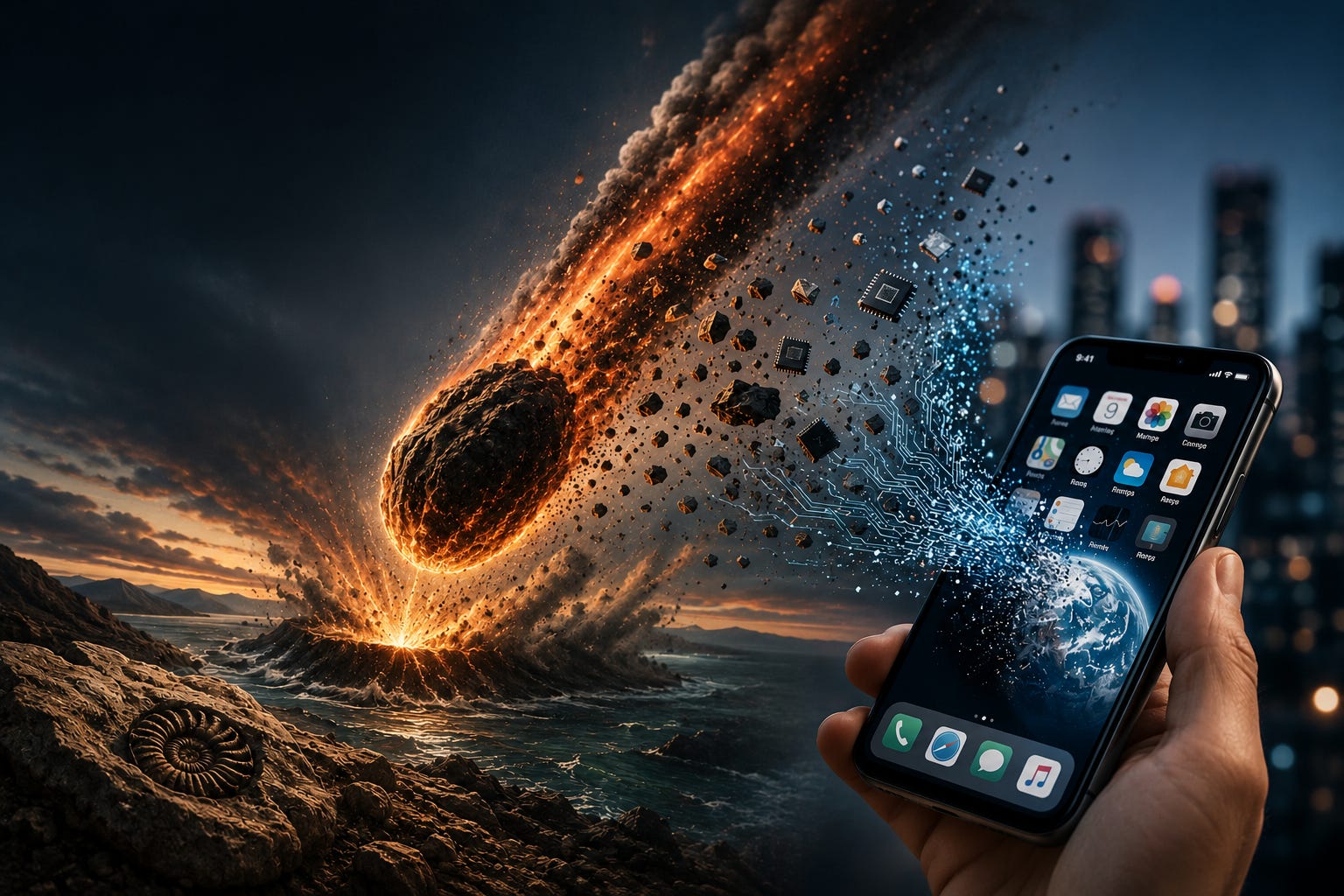
From a geological perspective, the smartphone is not a gradual shift. It is a meteor strike. Evolution will eventually adapt. It always does, but evolution measures time in thousands, and often millions, of years. The smartphone has been with us for less than two decades. From the perspective of human evolution, the meteor has only just landed.
LOOKING AHEAD
If this hypothesis is correct, then the paradox that began this article becomes clearer.
The smartphone connects billions of people while simultaneously replacing portions of the multisensory environment in which human relationships evolved with an information-rich, sensory-reduced environment. This environmental shift may help explain why increasing digital interaction has coincided with increasing reports of loneliness and anxiety.
Artificial intelligence now raises an even larger question.
If language alone is insufficient to fully reproduce human relationships, what happens when our most meaningful conversations increasingly occur with entities that can reproduce language, but not the full sensory experience through which human relationships evolved?
The smartphone may have been the beginning of this story.
AI companions may be the next chapter.
Part Two explores what happens next.
Hadn’t heard that thesis before. Very interesting Erik.
Great thesis and thought provoking. I believe a factor might be the volume. We are bombarded by so many potential connections that we can’t or don’t connect.