
It started with a hack.
I was a daily Facebook user for more than 15 years until, in April 2022, I was abruptly cut off through no fault of my own. My account was hijacked, even with two-factor authentication (2FA) enabled. Several of my financial accounts were also compromised. Companies like AMEX, PayPal, and even Yahoo! stepped in to help. Facebook did not.
For 30 days, I did everything humanly possible to recover my account. I submitted documentation. I followed their protocols. I pleaded with automated systems and support queues. Once my account was labeled “permanently disabled,” I was left with nothing but disbelief and anger. I didn’t just lose 15 years of content. I lost the digital context of friendships, shared moments, milestones, and messages that could never be recreated. Read the full story: Too Big Too Care
That experience was more than frustrating; it was a wake-up call about the dangers of centralized digital identity. It also marked the first time I seriously began reflecting on what it meant to be Gen X. Not just in how I perceived Big Tech, but in how I saw my place in a world that is being rapidly redefined by technology.
And that realization brought me to a larger truth. Gen X is the best-equipped generation to manage the digital transformation. The sweeping, ongoing shift from analog systems and human-centered processes to digital platforms, automated infrastructure, and centralized technologies that now shape how we live, work, connect, and define ourselves.
WHO ARE THE GENERATIONS?
Before diving deeper, it's worth defining the generational cohorts:
Traditionalists: Born before 1945
Baby Boomers: 1946 – 1964
Generation X: 1965 – 1976
Generation Y (Millennials): 1977 – 1995
Generation Z: 1996 and later
WE WERE THF FIRST DIGITAL NATIVES
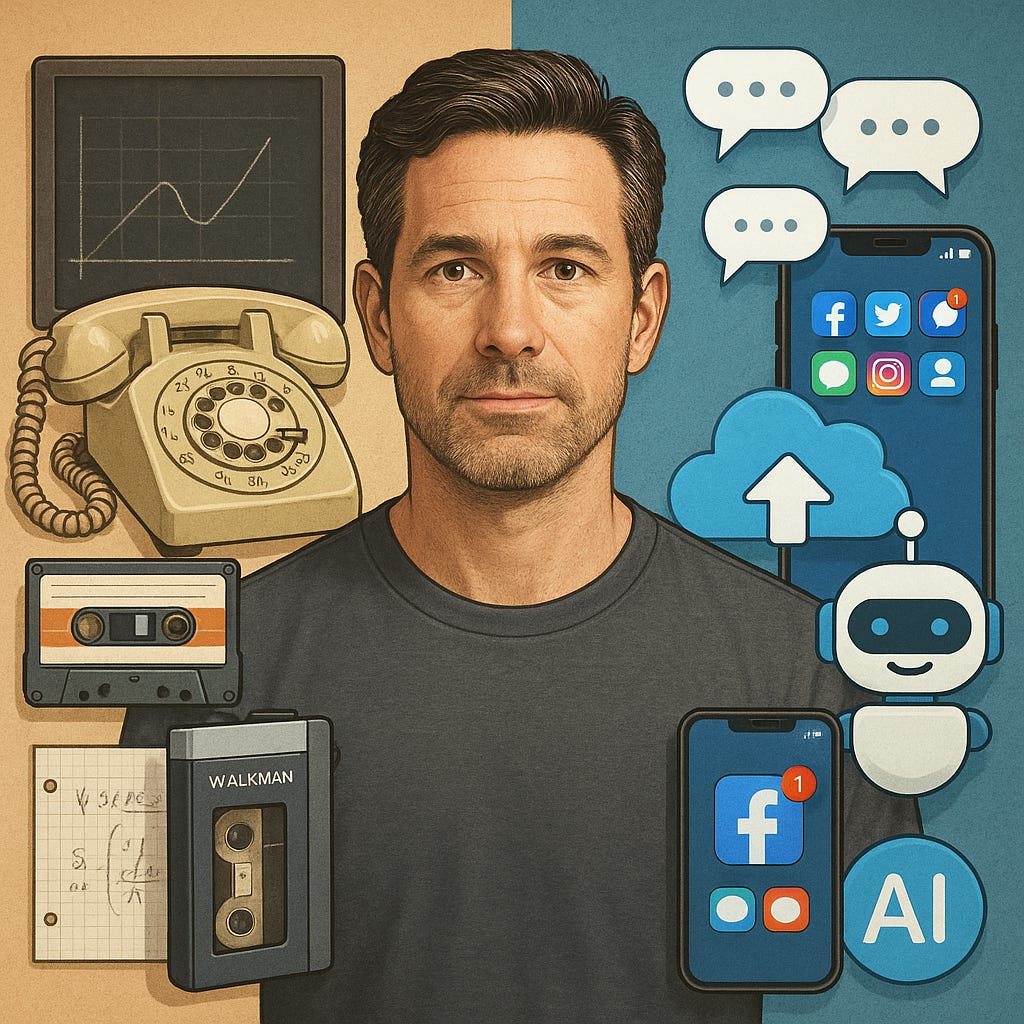
Gen X didn’t grow up with the internet in our cribs. We grew up outside riding bikes until the streetlights came on, and often long after. In our youth, we listened to 8-tracks, flipped records, and rewound cassette tapes with pencils. We were the Walkman generation. We memorized phone numbers, called friends from rotary phones, and met people face-to-face. We were in middle school or high school when MTV first hit the airwaves, bringing with it a cultural revolution. We witnessed the rise of hip hop, grunge, punk, and the birth of music videos as both entertainment and political expression. This exposure gave us a sense of how quickly media could shape society.
We were the first generation to grow up alongside the personal computer, from the Apple II and Commodore 64 to early PCs, DOS, Windows, OS/2, and dial-up. When the internet arrived, we were ready. We logged on. We adapted. We learned the languages of HTML, embraced AOL, explored chatrooms, and mastered email and file-sharing. Unlike Gen Z, who were born into a digital culture, or Boomers, who had to confront it later in life, we were the first to truly choose the digital world. What truly sets Gen X apart is our grounding in cultural memory.
We deeply understood the impact of World War II because we were raised by parents and grandparents who had lived through it. We were children during the Vietnam War. Young enough to be shielded from its horrors, but old enough to grasp the national trauma and recognize the mistakes. We internalized history not just from textbooks but through lived conversations around kitchen tables and Memorial Day ceremonies.
DIGITAL FLUENCY, REAL-WORLD ROOTS
Older Gen Xers are just beginning to turn 60, a milestone that puts their experience in a unique generational light. Many of us spent the first 20+ years of our careers commuting to physical offices, sitting in cubicles, attending in-person meetings, and building our professional lives face-to-face. Remote work and video calls were fringe concepts until the late 2000s. We were trained in the analog rituals of office culture before seamlessly transitioning to Zoom fatigue.
Gen Xers were the last to build their social networks in person before extending them online. We went to school without smartphones and built relationships before social media. This gives us a grounding that younger generations often lack. We don’t conflate connectivity with connection. We know how to shake a hand, write an email without Gen AI, and have a conversation without emojis or abbreviations. We also know how to scale those relationships digitally.
WE ARE THE TRANSLATORS
In workplaces, Gen X is the bridge. We manage Baby Boomers above and Millennials/Gen Z below. We translate across analog and digital.
We're not overwhelmed by change, but we're not addicted to it either. We know how to debug a printer and reboot a cloud server. We can code a website and manage a boardroom.
We’re bilingual in a way no other generation is and fluent in both eras.
CONCLUSION
My experience with Facebook was infuriating. Not just because I lost access to my account, but because it exposed how fragile our digital identities truly are. In that moment of vulnerability, I needed a company to care. Facebook didn’t.
That experience also reminded me of something else, the unique strengths my generation brings to the table.
We built relationships in both worlds, analog and digital.
We’ve adapted without losing our health, our humor, or our humanity.
Our anxiety doesn’t come from screen time, it comes from watching the rising anxiety, loneliness, and depression in both our kids and our aging parents.
We understand what’s being lost and what we’re still at risk of losing.
The digital transformation isn’t just about faster processors or smarter AI. It’s about what kind of society we become as the line between human and machine grows thinner, fuzzier, and harder to trace.
Gen X remembers what empathy looked like. We remember when trust was earned, not optimized. And that’s why, more than any other generation, Gen X is best equipped to lead the digital transformation.
Not because we’re the loudest.
Not because we’re the most wired.
But because we still remember what came before and what must endure.
We are the Second Greatest Generation. And if that resonates with you, you’re probably Gen X.
Spot on, Erik!
This so accurately describes the Gen X reality. It rings so true to me and matches things I've shared with my Gen Z kids. Brilliant!