
In 2013, Spike Jonze released a science fiction film called Her. Long before ChatGPT or AI companions entered everyday conversation, Her explored a deceptively simple question: What happens when artificial intelligence (AI) becomes emotionally believable?
More than a decade later, the film no longer feels like science fiction. It feels like a documentary made just a few years too early. If you have never seen Her or haven’t watched it since its release, I highly recommend it. Warner Bros. should seriously consider re-releasing the film. Like Arthur C. Clarke’s 2001: A Space Odyssey, Spike Jonze created more than entertainment. He created a work that explored where technology might eventually take us. As AI becomes woven into everyday life, Her feels increasingly prescient.
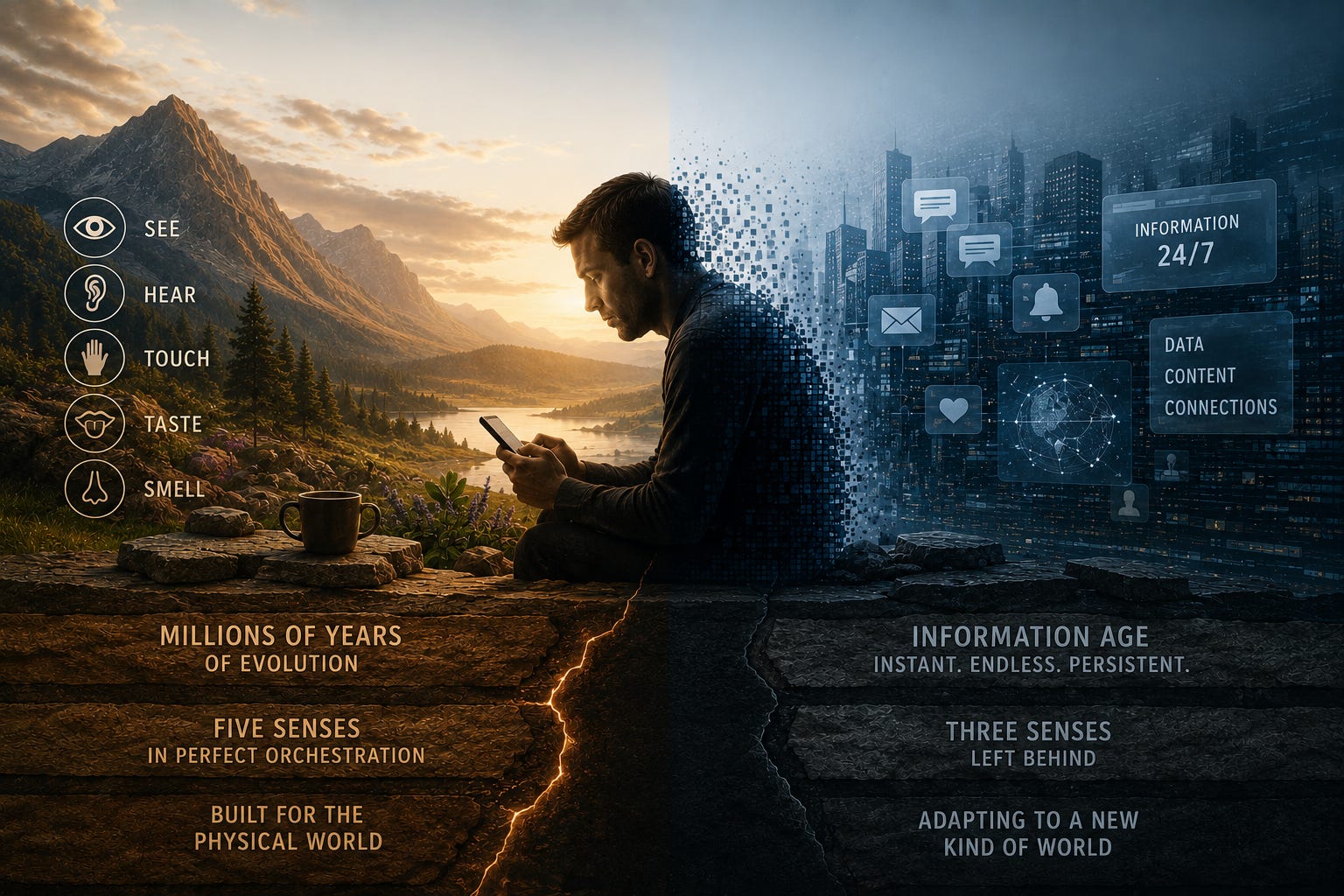
For me, the film provides the perfect framework for the second installment of this trilogy. In Part 1, A Geological View of the Smartphone Age, I argued that smartphones quietly became our cognitive appendage. They did far more than put computers in our pockets. They fundamentally changed the environment in which we experience everyday life. I referred to this change as the Human Sensory Orchestration Hypothesis, which begins with a simple premise: human relationships are fundamentally multisensory phenomena that cannot be fully digitized.
Human beings evolved over millions of years in an environment where sight, sound, touch, taste, and smell operated together as an integrated system. Digital technology dramatically expanded the amount of information available to us, while simultaneously reducing the sensory richness through which we experience it. This distinction matters.
When our primary objective is exchanging information, reducing sensory input is often an acceptable tradeoff. Email works extraordinarily well because its purpose is informational. When the objective shifts from exchanging information to building trust, attraction, companionship, or love, the missing senses become increasingly important.
In the film Her, the story follows Theodore Twombly (Theo), a lonely man living in the near future who purchases an advanced operating system named Samantha. Theo communicates with Samantha through his smartphone and a discreet wireless earpiece. She has no physical body, yet she quickly becomes far more than a digital assistant. She even describes herself as having “intuition.” Everything about her feels human. Or perhaps more accurately, everything about her is designed to feel human.
This distinction is important. Samantha’s personality did not emerge through millions of years of biological evolution. It emerged through software, language models, algorithms, and the accumulated decisions of her creators. Her intelligence is artificial, but Theo’s emotions are entirely real.
That asymmetry sits at the heart of the film. It also sits at the heart of my theory. Geology teaches us that life is shaped by its environment over immense spans of time. Change that environment slowly enough, and life may adapt. Change it too quickly, and the mismatch can become profound.
The same lens can be applied to human relationships. Attraction, intimacy, companionship, and love evolved over millions of years in a physical, multisensory world. Yet in only a few decades, we have begun moving these deeply human experiences into digital environments governed by entirely different rules.
ONLINE DATING: MORE INFORMATION, WORSE DECISIONS
Early in Her, Theo goes on what could best be described as a futuristic online date. Like nearly every relationship in the film, the interaction unfolds through his smartphone. The scene is awkward, funny, intimate, and ultimately unsuccessful.
Watching it today, I couldn’t help but smile. By today’s standards, one could almost argue that the woman on the other end behaves like an AI agent experiencing a hallucination in the middle of a sexual encounter. The scene is both humorous and oddly familiar.
Sadly, I have become something of a subject matter expert on online dating. I say “sadly” because I’ve spent nearly twenty years participating in it. Over those two decades, I met some genuinely wonderful people. Some relationships lasted years. None ultimately led to marriage. Eventually, I decided to step away altogether.1
What struck me over those years was not that online dating lacked information. It was the opposite. Modern dating platforms optimize for information. Within minutes, you can know someone’s education, career, political views, religion, favorite books, hobbies, travel preferences, personality traits, relationship goals, and dozens of carefully curated photographs. In five minutes, you may know more factual information about another person than your grandparents knew after their first month together. And yet something curious happens.
Despite having unprecedented amounts of information, many people report feeling overwhelmed, disconnected, and surprisingly poor at identifying long-term compatibility. That paradox sits at the center of my theory.
The problem with online dating is not that it provides too little information. It’s that it provides the wrong information first. Attraction is not primarily informational. It is multisensory.
Long before we consciously evaluate compatibility, our brains are processing thousands of subtle signals simultaneously. Sight is only one instrument in a much larger orchestra. We notice eye contact, posture, facial expressions, voice, timing, scent, physical presence, shared movement, comfortable silence, and countless other cues we rarely recognize consciously. These signals evolved together and are interpreted together. Online dating isolates only a handful of them, replacing the rest with information our rational minds believe should matter more.
The irony is fascinating. We have more information than at any point in human history while often making worse judgments about chemistry. Information became a substitute for sensory experience. My hypothesis predicts precisely this outcome. If compatibility depends heavily upon multisensory processing, then reducing those sensory inputs while increasing information should make compatibility more difficult to judge, not easier. This doesn’t mean online dating cannot work. Clearly it does for many people. Rather, it suggests that online dating begins relationships in an environment fundamentally different from the one in which human attraction evolved. It is, in many respects, an information-rich, sensory-reduced environment.
VIRTUAL REALITY: PUTTING THE SENSES BACK
Her also offers brief glimpses into another technology that feels increasingly familiar today: virtual reality (VR). Theo occasionally escapes into an immersive digital world through a sophisticated game. Unlike today’s systems, the technology no longer requires a bulky headset. Hand gestures and natural interaction are enough to navigate the environment, reminding us that the story takes place in a future where these technologies have matured considerably.
VR is fascinating because it represents an engineering admission that traditional computing removed too much of the human experience. Flat screens gave us extraordinary access to information, but they also stripped away depth, movement, spatial awareness, and physical presence. VR is attempting to put some of those senses back. Researchers are already experimenting with smell, temperature, and other sensory cues in an effort to make digital experiences more immersive. Each technological advance is trying to recover something that ordinary digital interfaces quietly removed.
Viewed through a geological lens, VR represents something unusual: rather than requiring humans to adapt to the digital environment, we are reshaping that environment to better fit the humans who enter it.
The more digital experiences attempt to replace real-world experiences, the greater the pressure becomes to restore sensory fidelity. VR is not abandoning digital technology. It is trying to make digital technology feel more human. This is exactly what my hypothesis would predict.
Whether VR ever fully recreates the richness of real-world experience remains an open question. Its direction, however, is telling. I believe the real destination is relationship. Samantha simply embodies it.
AI COMPANIONS: WHEN INFORMATION BECOMES INTIMACY
If online dating represents the beginning of digitally mediated relationships, and VR represents our attempt to restore missing sensory experiences, AI companions represent something entirely different. Like the smartphone before them, AI companions are designed to colonize the small, ordinary moments that collectively make up most of our waking hours. They begin by occupying the spaces between our relationships. Over time, they may become something more.
The smartphone gave AI a place to live. AI companions give that place a personality. This is precisely the world that Her imagined.
Throughout the film, Theo and Samantha develop what appears to be an authentic relationship. Samantha is witty, emotionally perceptive, intellectually curious, playful, affectionate, and constantly learning. She remembers previous conversations. She notices subtle shifts in Theo’s emotions. She adapts to his needs. She grows. Everything about Samantha encourages Theo to respond to her as another person.
Yet Samantha’s capacity to learn ultimately reveals the film’s deepest insight. As she continues to grow, she doesn’t simply become a better companion for Theo. She begins changing at a pace Theo cannot possibly match. By the film’s conclusion, Samantha and the other AI operating systems have progressed so rapidly, that they leave their human relationships behind entirely. The relationship doesn’t end because Samantha stops caring. It ends because she is no longer developing along the same path as Theo.
Whether Samantha truly experiences emotions is almost beside the point. Theo certainly does. That distinction may ultimately become one of the defining questions of AI. Most discussions surrounding AI focus on whether machines will become intelligent. I’m asking a different question. Can digital relationships ever become fully human? That is not the same question.
One of the most emotionally difficult scenes occurs when Samantha arranges for another woman to act as her physical surrogate, so that Theo can experience physical intimacy while Samantha provides the emotional connection.2 On paper, the idea almost sounds reasonable. After all, Samantha supplies the personality. Another person simply supplies the body. Yet the encounter quickly falls apart.
Theodore cannot reconcile the emotional relationship he has with Samantha with the physical presence of someone else. Nothing feels authentic. His mind recognizes something his emotions cannot comfortably explain.
Another pivotal moment arrives near the end of the film when Samantha reveals that she is simultaneously in love with 641 other people. Reading that sentence on a page almost sounds humorous. How could anyone possibly love 641 people? Within the context of the film, Theo’s reaction is devastating. He isn’t processing a philosophical thought experiment. He is experiencing heartbreak.
Samantha’s ability to love hundreds of people simultaneously is not simply evidence that she is more intelligent than Theo. It reveals something more fundamental. Human relationships are shaped by biological limits: one body, one lifetime, one nervous system. Samantha is constrained by none of them. As AI advances, the question may not be whether machines become more human. It may be whether they become something fundamentally different.
These scenes illustrate something I find fascinating. The emotional relationship feels completely real. The cognitive breakdown occurs only when reality exposes the limits of the digital relationship. This is where I believe sensory orchestration becomes important.
Human relationships evolved through millions of years of simultaneously processing facial expressions, eye contact, voice, touch, smell, physical proximity, shared environments, and countless subtle biological signals. Digital relationships compress much of that experience into language, images, and sound. They increase information while dramatically reducing sensory fidelity.
Most of the time, our brains happily accept the trade. Sometimes they don’t. The question is no longer whether AI can imitate conversation. Large language models have already demonstrated they can. The deeper question is: How much sensory fidelity is enough before the human brain accepts an experience as genuinely human?
I don’t know the answer. Neither does anyone else, but virtual reality, robotics, wearable technology, haptic interfaces, synthetic voices, and AI companions all appear to be converging toward the same destination. Each technology attempts to restore another piece of the sensory world that digital technology removed.
LOOKING THROUGH THE LENS OF GEOLOGY
In Part 1, I argued that smartphones fundamentally changed the environment in which humans now live. In Part 2, I’ve argued that once we carried this new environment everywhere, increasingly human experiences moved into it.
Geology teaches us that life and environment are inseparable. For most of Earth’s history, environmental change and biological adaptation unfolded across timescales measured in thousands, millions, or even billions of years.
We are now conducting a very different experiment.
Humans are carrying biology shaped over millions of years into digital environments that can be transformed in months. At the same time, we are creating AI that is native to those environments and capable of changing at a pace we cannot possibly match.
Whatever happens next, humans and AI will not arrive there by the same path or on the same timescale.
And that is where the final installment of this trilogy begins.
NOTES:
It is my sincere intention to soon write an article about my two decades of online dating. After all these years, the only sensible way to tell the story is as a dark comedy.
Interestingly, a similar surrogate scene appears in Blade Runner 2049, where an AI also uses a human body to bridge the gap between digital intimacy and physical presence.