
I’m ashamed and embarrassed to write this, but I’m also angry enough that I can’t not write it. Like many others, I didn’t end up here overnight. My second startup unraveled during Covid, and I’ve been trying to recover ever since.
I’ve been unemployed for 10 months and am still looking for work. I’ve run through my savings. At this point, I’m broke. That’s not where I expected to be after earning two graduate degrees, including one from MIT, and achieving real success in my career, including a successful exit from my first startup. For more than three decades, I’ve approached my finances with discipline; paying bills on time, avoiding debt, and building what I thought was a stable foundation. I followed the rules. Or at least, I thought I did.
Late in the evening on March 31st, I logged into my account to transfer a small amount from my home equity line of credit (HELOC) into my checking account, something I had done routinely for years. Over the past couple of months, I knew that even if I didn’t land a job right away, I had that line of credit I could tap into as a safety net. It provided a sense of relief in an already stressful situation. This time, the line of credit was gone. Closed. No warning whatsoever. Given the timing and everything else, I assumed it had to be a mistake.
The next morning, April 1st, I went into my credit union, the same institution I’ve been with since starting my career at IBM in 1990. I was told the HELOC had simply reached the end of its 10-year term and that I should reapply online. It sounded routine enough… It wasn’t!
After some issues with the online application, I ended up speaking with a loan officer I’ll call Mitchell, someone I knew from prior interactions at the credit union. He was professional, thoughtful, and genuinely tried to help. But the outcome was clear: I wouldn’t qualify, not because of bad credit or too much debt, but because I don’t currently have income. That was the entire calculation. In that moment, I couldn’t help but think of the line from Caddyshack: “You’ll get nothing and like it!” To his credit, Mitchell didn’t leave it there, he called me back twice afterward, trying to find alternatives. If anything, his persistence only reinforced that there simply wasn’t a path forward. I appreciated his efforts more than he probably realized.
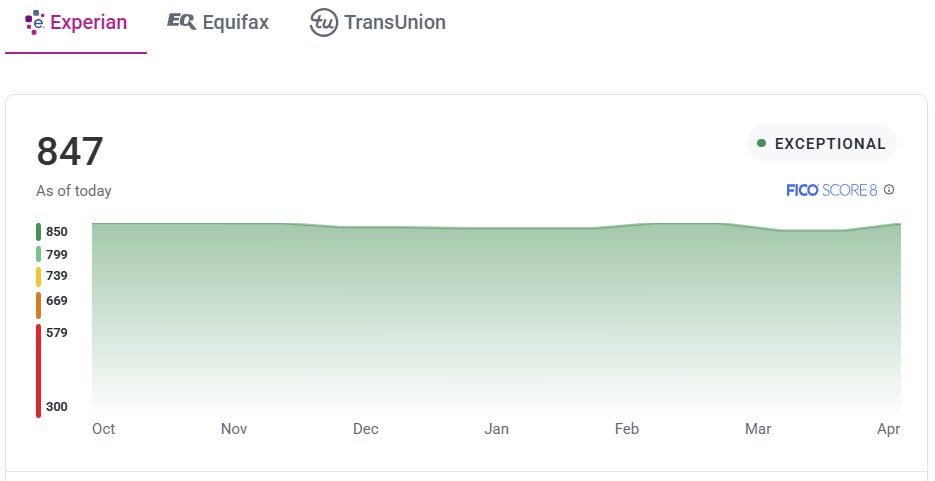
With a credit score of 847 out of 850, zero credit card debt, roughly $700,000 in equity in my home, nearly ten times what I was asking for, and retirement assets that could more than cover my obligations, I assumed I was the definition of a low-risk borrower. I’ve also been with the same institution for 35 years, across both personal and business accounts. None of it mattered!
What I encountered wasn’t a nuanced evaluation of risk, but a binary one. The system didn’t weigh history or assets in any meaningful way. It saw one thing, “No income,” and everything else effectively disappeared.
That experience forced a realization. We tend to believe that financial systems reward long-term responsibility, and that discipline and consistency over time will matter when it counts. But what the system actually rewards isn’t discipline or responsibility; it’s whether you have income at the time of the loan application. As long as income is present, you are ‘low risk.’ The moment it isn’t, even temporarily, that definition changes entirely.
I don’t fault Mitchell in any way. He’s operating within a system designed to minimize uncertainty, not interpret context. But if someone with a near-perfect credit profile, significant assets, and decades of discipline is effectively locked out at the moment they need short-term flexibility, then it’s worth asking what the system is actually optimizing for.
I’ll work through this. I always do. And to my friends reading this, I know you’ll likely reach out, and I appreciate that more than you know. But please don’t worry, and there’s no need for anything crazy like a GoFundMe page 😊 I also know unemployment exists for exactly these situations, but for me, I just haven’t been able to bring myself to go down that path after everything I’ve invested in my education and career. That may be right or wrong, it’s just where I am at.
For most of my adult life, I believed in a kind of social contract: go to school, work hard, pay your bills, and the system will be there when you need it. On April 1st, I learned something else: It doesn’t reward responsibility, it rewards something much narrower: a single snapshot in time, whether or not you have income at the moment you apply.
After 35 years, I believed my bank would be there for me when it mattered. I was wrong. When that income isn’t there, the options don’t disappear, they just get worse. Take on promotional credit that eventually resets, pushing you into credit card debt, the very thing I’ve avoided my entire life. Or, start paying penalties to access your own retirement.
If that’s how we define risk, then we haven’t built a system to support people, we’ve built one that turns its back on them the moment they actually need it.
This is so disappointing, Erik, to say the least. Health insurance in the US is similarly infuriating, as it is good when you’re well and employed, but if you get sick and cannot work, you loose it… just when you need it. It’s disheartening that you can follow the rules, and not have a safety net.
So frustrating! Sad state when you have a perfect credit score and the bank won’t work with you when you need them most!?